ACT 2 in Birmingham
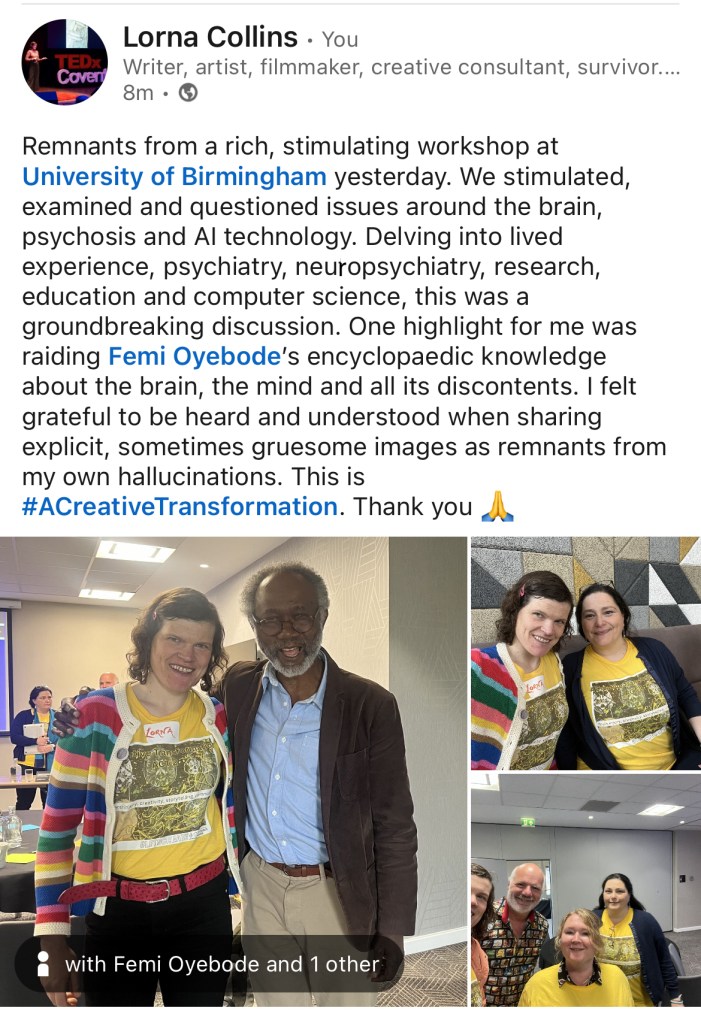
This was an experimental workshop examining psychosis, the brain and AI technology, held at the Edgbaston Hotel, part of Birmingham University. Lorna spoke about her lived experience of psychosis after brain injury. The renown psychiatrist, Femi Oyebode (a living encyclopaedia) spoke about medicine, psychiatry, hallucinations and AI technology. He gave the example of someone with phantom limb syndrome, when they’ve had a limb amputated and they have a hallucination because they feel as though they still have their limb, they have a lot of pain in something that is not there. Femi described an experiment to relieve or correct the pain of a phantom limb, using basic manual technology. So interesting. After Femi, Ruta Kontautaite spoke. She is a neuropsychiatrist, and she gave an overview of neuropsychiatry and AI technology, in relation to her own fascinating work. This was a very useful grounding to the topic. Finally, in the morning, Roxana Baiasu gave her talk, which included a philosophical perspective surrounding AI technology, the brain, mental illness and psychosis.
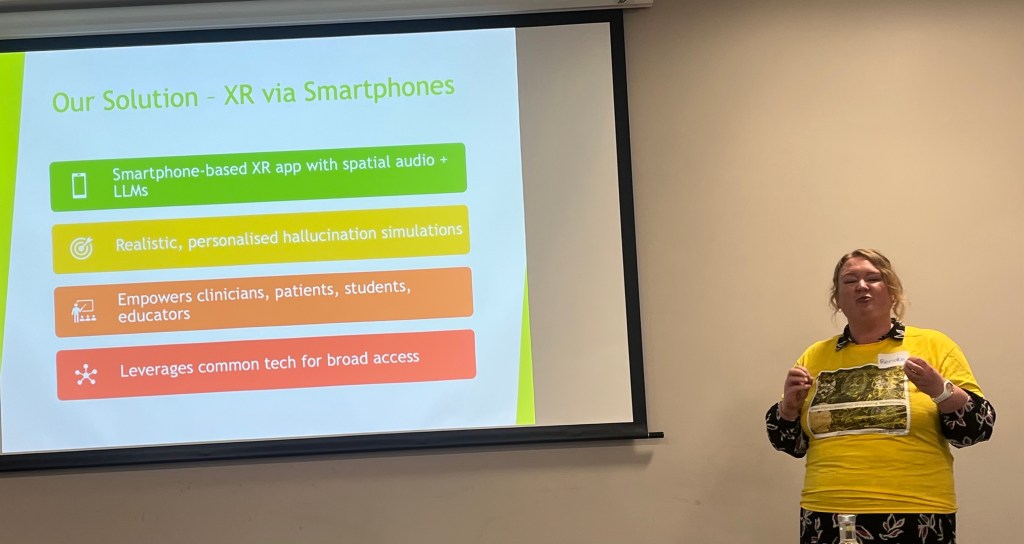
After lunch, Russell Beale and Renata Reniers presented their smart phone app technology which uses AI to simulate hallucinations. The purpose of this is to educate healthcare professionals so they can have more empathy with their patients. Renate gave some background of the technology they are using on a smart phone app to put sounds and voices in different areas of space to simulate hallucinations. They want to upscale this device and use it in large spaces to educate medical students and healthcare professionals. They hope that the sound device will copy and express and evoke and simulate what it is like to have a hallucination.
Russell explained some of the science behind creating sound in different areas of space. He played a recording of different sounds and voices in the room. The recording was played on a laptop computer, so – he said – it wasn’t as effective as when it’s played in headphones, where it can be like a surround sound. The recording only lasted a couple of minutes, but it had a very strong effect on participants in the room. Each table discussed our experiences of the recording and what we felt it could do to educate healthcare professionals and medical students. We experimented with ideas and applications around the brain, psychosis and AI Technology, considering ethical challenges to this app, as well as practical ones. The app clearly has huge potential to show people what it is like to have auditory hallucinations. The team have interesting and useful technological resources to support what they are creating. It will be interesting to see how the app develops in an inclusive and ethical way, in the context of staff training or (later) in treatment settings.
Renate speaking about the XR App
In the future, we could consider how AI can be used to create an experience that is accurate but somehow not overwhelming or scary (as a hallucination can be). The app provides options for patients to respond to their (AI recreated) hallucination, have a conversation with it and in this way transform what is scary into something that becomes manageable. The technology then develops into a creative engagement with the ‘voices’ and the sound representations, by allowing one to respond to them and express oneself. The app could produce empathy and at the same time make the hallucinatory experience manageable, by creating a creative and transformative space in which one can respond to and potentially reconfigure the hallucinations.

(Image taken from Dr Ruta Kontautaite’s talk at the Birmingham event).
Feedback from participants:
Thoughts on the Spatial Experience
- I think it would be helpful to have generic ambient sound as the bottom layer to the sounds to help localise them in normal situations. For instance – café bar ambience underneath the voices or car radio and driving sounds but with the voices.
- Ethical implications for activating people who may have latent psychosis.
~
Thank you for the invite to attend this event. I really enjoyed the content of the day and wish you had full attendance – shame on those that dropped out!
I think that the day may have been better served if the narrative of the day was better explained, so that I know how best to contribute and the relevance of the presentations. But I did navigate the day well and enjoy.
Psychology – Public Involvement Lead.
~
Great day. This was a really interesting day which raised lots of questions for me. Lorna was brilliant and her honest was refreshing. Femi was fascinating – would love to hear him talk more as he is so knowledgeable. Thank you so much.
Consultant Nurse
~
Thank you so much for today it has been an incredibly moving and informative day. It has been a day where I will go away with lots of questions to ponder. I look forward to hearing more about how you use art to help heal.
Art Psychotherapist
~
Thank you for the session Very interesting, inspiring and engaging
Research Associate
~
THANK YOU!
- Great interdisciplinary mix of sessions
- Nice open discussion – and appreciate your honesty re knowing little about AI, I’m in the same boat!
- I feel like I’ve learnt today about how AI/technology could be used in clinical practice as I had no idea before.
Research Associate in Psychology
~
Thank you a lot ❤
Psychology, Psychotherapy
~
Future plans:
…in conversation with the speakers and participants at the workshop:
We are interested in using AI to create an experience that is accurate but somehow not overwhelming or scary (as a hallucination can be). We want to build an app that provides options for patients to respond to their (AI recreated) hallucination, have a conversation with it and in this way transform what is scary into something that becomes manageable. The technology then develops into a creative engagement with the ‘voices’ and the sound representations, by allowing one to respond to them and express oneself. The app could produce empathy and at the same time make the hallucinatory experience manageable, by creating a creative and transformative space in which one can respond to and potentially reconfigure the hallucinations.
…Watch this space…
 A Creative Transformation