NHS staff training sessions
Training sessions for clinicians, nursing staff and AHPs who work with people who have brain injury, neurological conditions, trauma, hallucinations and/or mental illness. We examine how creativity can positively impact people who have experienced brain trauma, and the role that art and film can play in the context of NHS treatment programmes.
We ran sessions with the following NHS Trusts:
1. Warneford Hospital, Oxford Health NHS Foundation Trust, 04/06
Lorna’s blog from the Warneford Hospital:
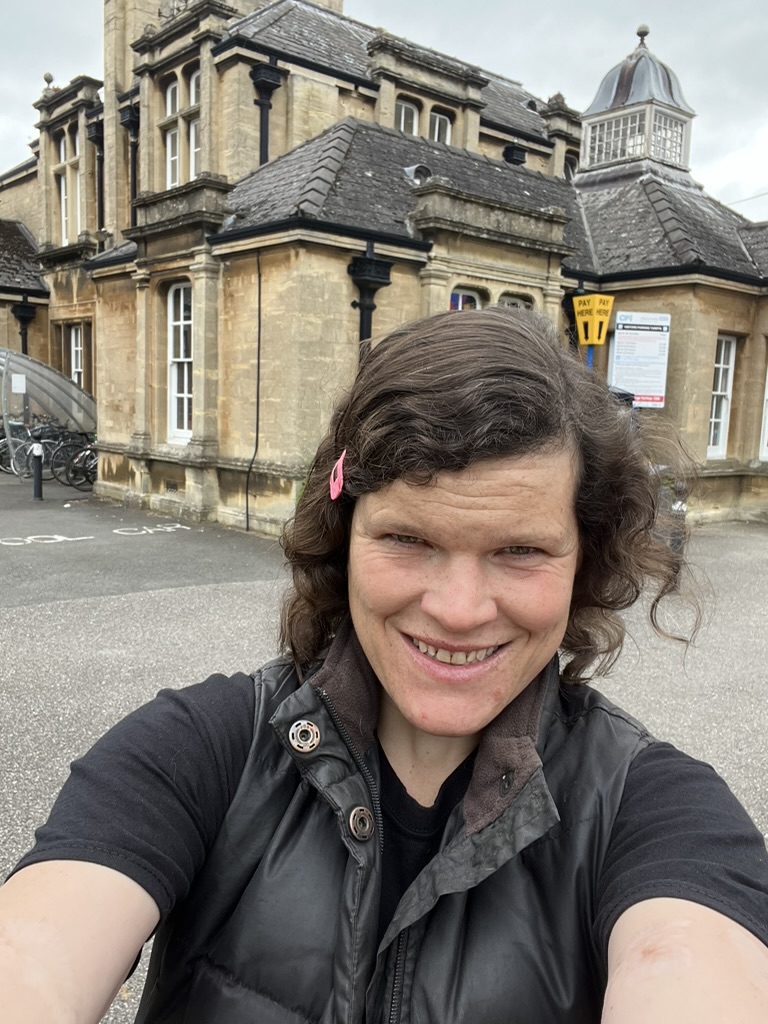
It went really well! I arrived, the film crew arrived, we met Tom (who was helping to set up) and we went to the Day Hospital. It was not hard to get the room ready – it was a perfect space. 6 people turned up, which was a nice number. I have their consent forms. They were really engaged with the material and asked lots of questions. They loved watching the film and also really liked the focus on art and how art has helped me with my recovery. I half recognised one person who came – it turned out he was a nurse during one of my admissions at the Allen Ward, when I was very sick indeed. It was really nice to show him and the other participants how it is possible to get well and live well, and to explain the role that art and creativity have played in this process. The hour went really quickly, but there was enough time – ample time for discussion. Several people stayed behind to connect with me further. The nurse who I recognised asked me if I would go to talk to patients on inpatient wards. I said I would love to do this – an avenue for future projects. Apparently the film crew got some great footage for the feature documentary film they/we are making.
Learning points:
~ The performative art stimulus I presented was a bit chaotic and hard to manage – need to change this for the next NHS workshop at UCLH.
~ People seemed to really enjoy scribbling their own thoughts and reactions onto the brain printouts with coloured pencils and pens.
~ People were fascinated with how art helps in my recovery and my daily life now – as a practical coping mechanism. How this could be conveyed to support patients (and staff supporting patients), specifically in inpatient settings.
~ Crucially, we discussed a central question, ‘What is recovery?’, and how art/creativity can support a notion of recovery as not an absence of symptoms, but living with symptoms (e.g. hallucinations) and living well, rather than responding destructively to them. We discussed how art can contribute to this notion of recovery, and how it can be applied to patients who are currently very unwell.
~ Talking with Tom at the end – he described how to support people/patients to open and engage with their imagination, when they are kind of closed up to it and find it really hard to express themselves. I would like to talk to Tom more about this – he has specific exercises. Perhaps we could work together on some kind of intervention here.
Feedback from participants:
The film and first part were interesting. Lorna definitely excels when telling her own story. The exercises were less good and harder to engage with. If expanding these workshops, just the presentation plus Q&A might work better. Or do a more art-focussed thing where people make a collage (a la Lorna) to express their feelings.
Lorna is so inspiring and it was beautiful to see both the artwork and how she’s used art to translate her subjective reality into an objective shared experience for others, to be able to understand. It really made me think about how art can be used to make sense of isolating experiences. So inspiring, so grateful to have been part of this and would love to hear more about this team’s work!
Yes. It was good to here the lived experience of a person with psychosis and being able to live well. Her ideas about art and how it can help a person with various mental heath problems was also interesting.
Very interesting (you hardly ever get a look into someone else’s head like this) and also very relevant to my work. I recently submitted a grant suggesting creative workshops for young people who self-harm and was really excited to hear that Lorna was able to use art to avoid the need to self-harm herself – living proof that this might be a good way to help people express themselves.
2. Neuro Rehabilitation Unit, National Hospital for Neurology and Neurosurgery, UCLH NHS Foundation Trust, 13/06
Lorna’s blog from the NHNN
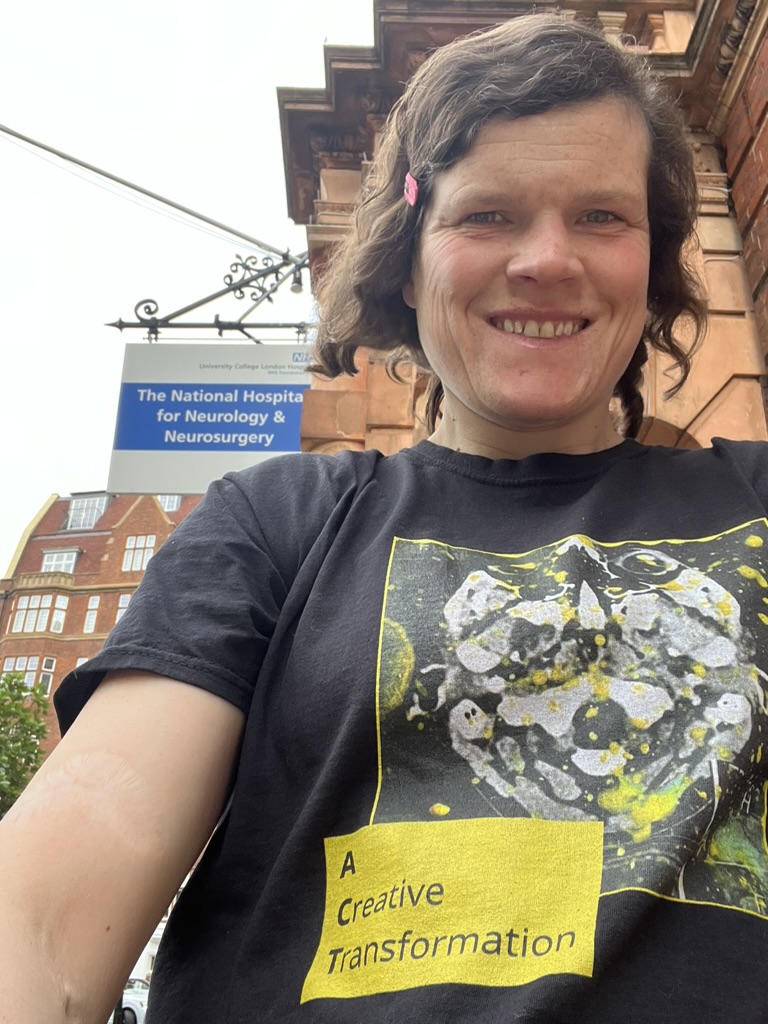
Many people came to my workshop. The room was full. Lots of very interested people who listen to me, connected with me and really wanted me to be there. This was a big moment for me. I felt heard, empowered, understood.
There must have been 30 people in the room. Doctors, consultants, nurses, therapists – everyone who worked in the vicinity of the neurology and neuro rehabilitation. I can’t express how brilliant it was. My talk did not overrun, there was plenty of time for questions and discussion, I relaxed into the room and I did not leave anything out. I did not use notes, I did not forget anything, I related what I said to the participants in the room and the neuro rehab unit. I said every brain injury is different, I only have my own experiences but… there are some points you or your patients might connect with. And they did.
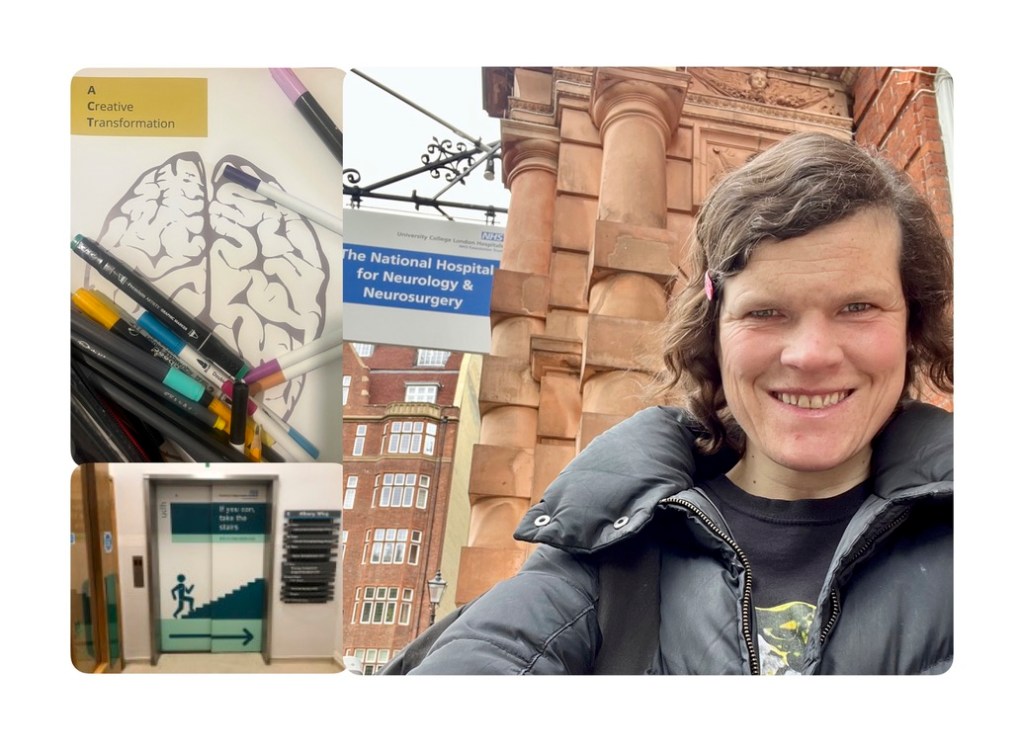
I had learned a great deal from the previous workshop in Oxford which was also successful and useful, but there were moments of it that weren’t very good — for instance the creative exercise didn’t work in Oxford, so I changed it in London, where I used the empty creative brain as a worksheet for people to fill in, however they liked. I gave them the sheet of paper with the open brain on it as a handout, at the beginning, when people came in to the room. I plonked a stash of pens, pencils and colours on the table, in a spread-eagled fashion, inviting people to pick and choose whatever they wanted. This was very popular, and participants really enjoyed the idea that they could respond creatively, however they liked, on their handout. They could make their brain their own. And I saw people scribbling and colouring in and writing notes and responding differently, everyone in their own, personal way. This was like applying what I was saying, so they could make their own notes and respond in their own ways and use creativity themselves, as I was talking about it.
The event workshop finished exactly 60 minutes after it started. Bingo on time. Precisely on the dot. There was a round of applause at the end, everyone was very cheery and smiling and grateful. and then they left because they had meetings and patients, but a few people stayed behind to ask me questions or suggest future ways to collaborate.
At the end of the session there was a great feeling of being uplifted and connected for future collaborations and future positive productive work – in and with A Creative Transformation. I felt the creative transformation in the room, as participants nodded and lit up when they connected with what I was saying, and with our interactions, when they asked me questions, or when they understood what I was trying to say to them about my experiences and my creativity, and what recovery means for me – not an absence of symptoms, but living with them, and living well.
 A Creative Transformation