ACT academic workshop at the Institute for Mental Health, University of Birmingham
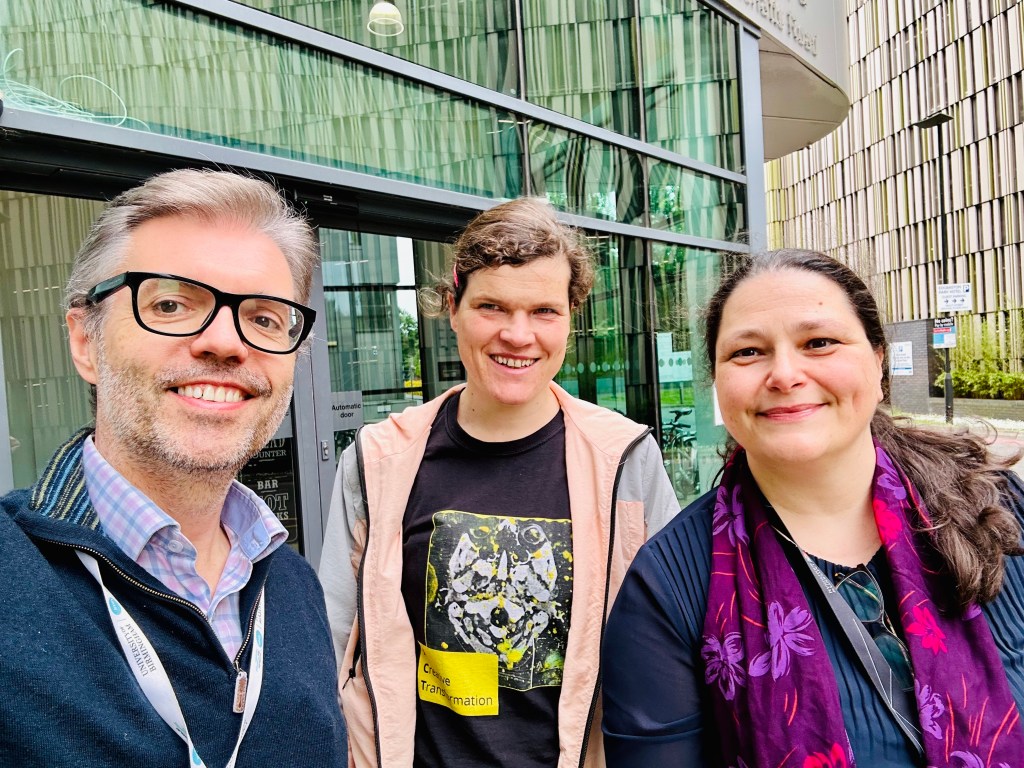
Panelists: Professor Matthew Broome, Dr. Lorna Collins, Dr. Roxana Baiasu.
Lorna’s blog about ‘A Creative Transformation’ in Birmingham:
I’m not sure whether it is Sunday or Monday. I think I have slept for about two hours. I am up now. Ready for the next day. But is it the same day? This temporal-existential-ontological question repeats itself in my daily routine. Insomnia.
I look at the clock. I never believe or understand the clock, with its linear notion of time. I think it says 9:30 pm. Time to get up. I am going to Birmingham for the next instalment of A Creative Transformation.
I do all my morning jobs around the farm. This involves taking care of the animals. It is a peaceful moment and I am aware of my senses. Several layers of reality hover and intermingle, as though they are at some social function, with me at the epicentre. I do not have time to watch, listen or react to these multilayered realities who throb from my sense organs. I observe and carry on.
Soon enough I have finished all my jobs. I go back to my house, get changed, load up all my bits and bobs and say goodbye to the dogs. Wilby stares at me with his soulful eyes and howls, demanding lunch, at 5 am. I give him a snack and say that somebody else will give him his lunch, later. I tell Mr. Tigga the cat to go and catch the rodents who have just awoken from their long, long slumber and are invading the roof.
I shut my back door and get in my car. My journey to Birmingham is smooth. I have time on the train to think about the event I am running, what I’m going to say, and do a bit of work. I am excited. I have never been to Birmingham before, and it will be interesting to see how the ACT project is received there, specifically in the Institute for Mental Health.
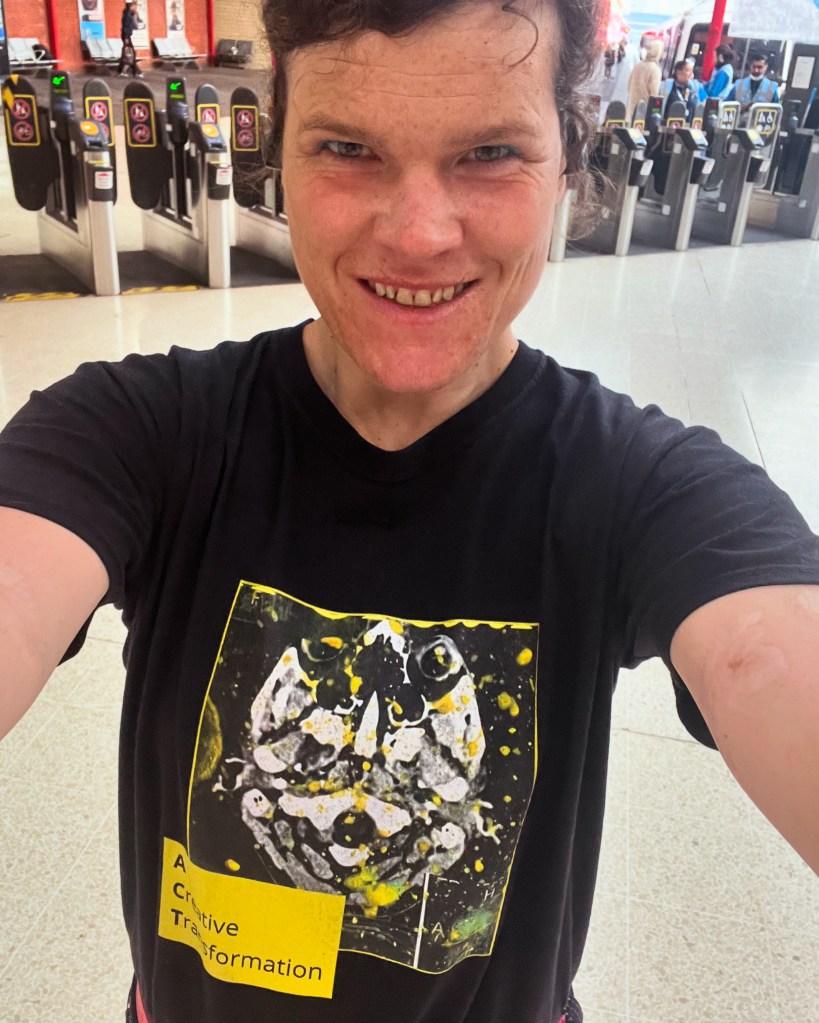
The train arrives in Birmingham. My friend and colleague Roxana is waiting for me. Very kind of her. Roxana is an Assistant Professor here at Birmingham, in the Institute for Mental Health. She also works in Oxford, where we ran the other academic ACT workshop, a few weeks ago.
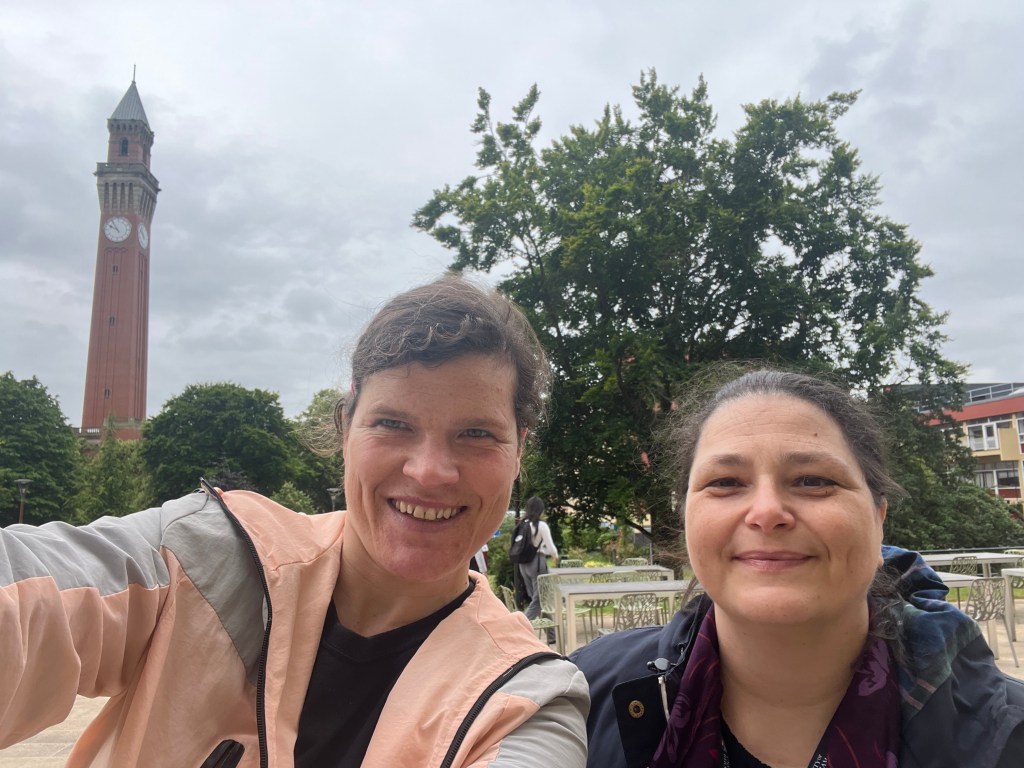
We walk to the School of Psychology, where the event is taking place. Everything is perfect. The room in which we are holding the seminar has very fancy technology which means that the hybrid component of the seminar will work efficiently and well. There is a camera with a 360° lens that follows whoever is speaking. Tracey is involved with the administration; she sets up all the technology effortlessly and with expertise. We are ready.
Professor Matthew Broome arrives. He is on the panel for this event with me and Roxana. He is not only an influential researcher, but also a gentle and compassionate doctor who works with people who have psychosis.
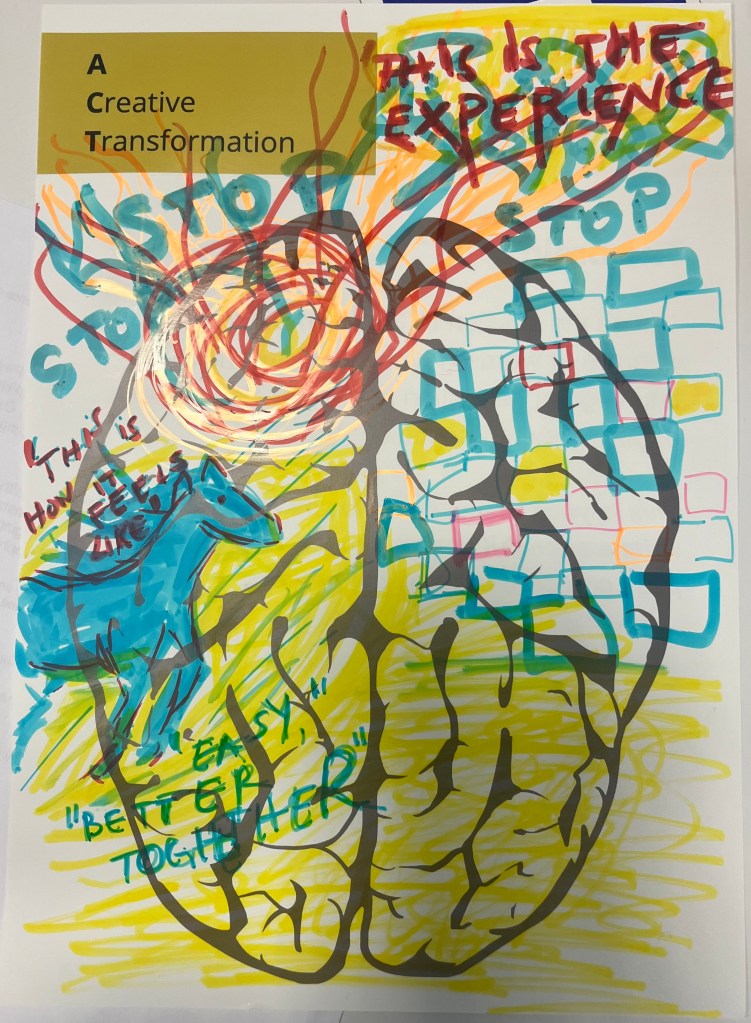
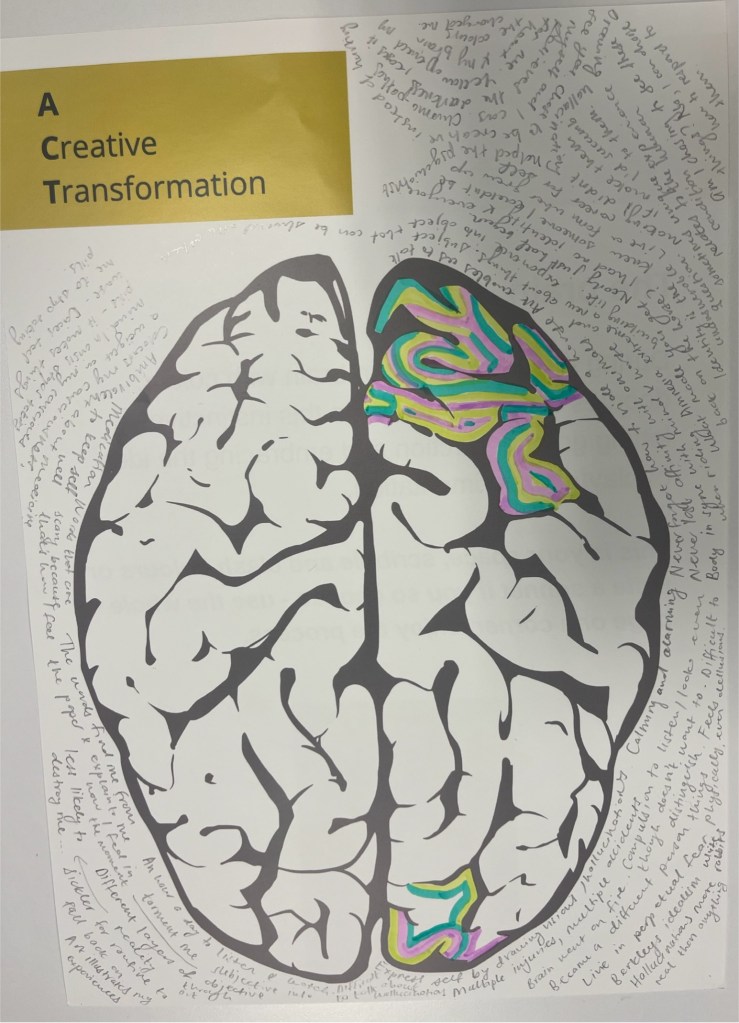
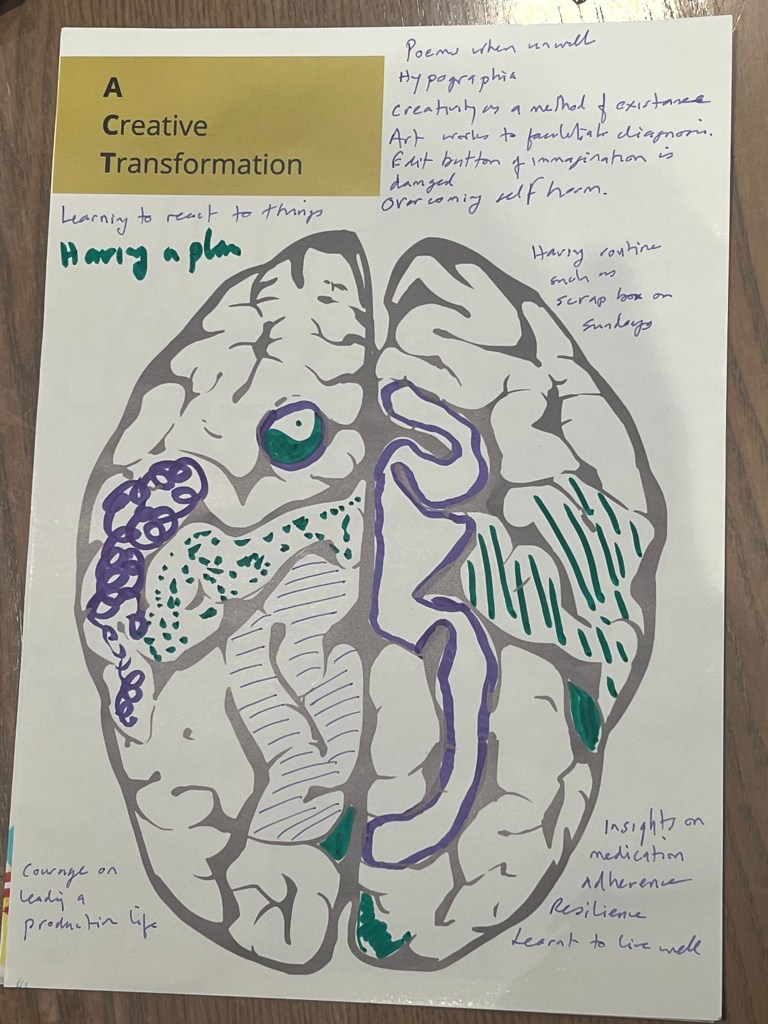
About 10 or 12 attendees turn up in real life and at least 30 or 40 people are joining us online. I am really pleased with this number. The room is bustling; people seem really interested, engaged and excited when I give them the handout of the ‘Creative Brain’ for them to scribble on with coloured pencils and pens. It is good that we have the technology to facilitate people joining us online as well.
Roxana introduces the seminar and we begin. I’m not sure if I say too much or the right thing, but I am connected with the participants in the room. Lots of nods. I hear people scribbling on the brain handouts. The discussion and questions are rich and helpful. Matthew makes some insightful comments and asks me about the different layers of reality I perceive, which are splashing about the room, in waves, as he speaks, and about my sense of identity after total amnesia. I try to see through the waves. Answering his questions helps me think further about what I’m trying to do with the ACT project. Roxana asks me about resilience and we develop the discussion that she and I are proposing in the paper that we are writing together. And then there are questions from people online and people in the room.
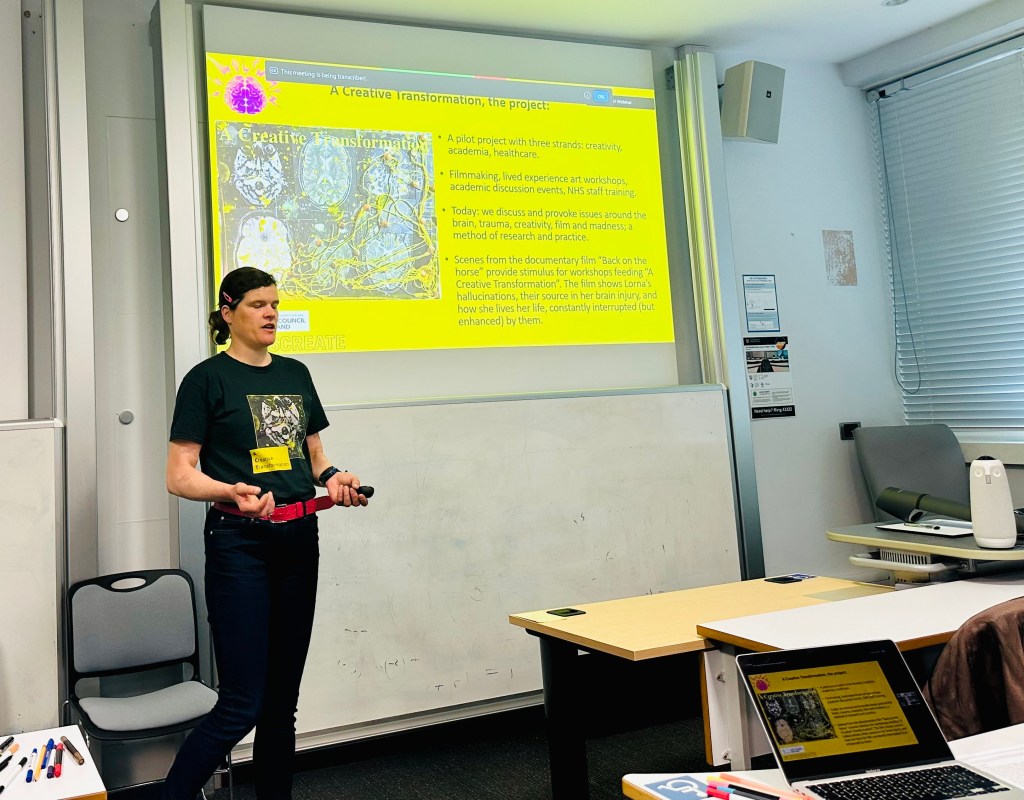
Many questions. One man who I recognise from previous mad events has three or four questions. The questions in the room develop the content of the seminar and give it depth. I talk about the idea that you can’t choose the experiences you have, but you can choose how you react to them. I can’t choose my hallucinations, but I can choose whether to react to them in a way which is destructive – I can do what they say, for instance, and self-harm, or I can choose to react differently. I can be creative, scream in a pillow, talk to someone, ride my horse, be with my dogs, go for a walk… there are lots of different ways to react to difficult stimuli. I’ve learnt how to choose to react in a healthy way.
Somebody asks me about whether the dark colours I use when I make art in response to feeling very unwell or having difficult feelings make it worse…if all the black reinforces the black. I say in fact it’s the opposite because the dark colours hold my darkness for me; they hold me, they hold that side of me, so I can let go of it. I find it incredibly helpful and essential to make art when I’m feeling desperate and dark, and the artworks I make do not perpetuate the darkness, they hold onto it, so the load is taken away from me and held somewhere safer. At the time I don’t necessarily want to let go of the darkness, because it’s so meaningful and it feels like that is the truth, but I also can’t stay with it because it is so much of a burden and because it is so painful. The artworks will express this, relieve it cathartically, and hold the difficult feelings, so I can be safe, leave them there and try to move on. We discuss these things and more. It is very meaningful.
We talk about identity and amnesia. I say that my situation is part of the human condition but maybe on an exaggerated scale. We all forget things as our lives evolve. Identities change as we go through life. My identity has changed catastrophically, so abruptly, but I have turned a full circle, in a way, because I have come back to live where I grew up, I still ride horses, although I still can’t remember my life previously.
Someone asks me, “So do you think you are the same person as you were before the head injury, after all?”
To be honest, I don’t know. Even if I am, I don’t know, because I can’t remember her, so I can’t really answer that question. There are fundamental differences. Coming to terms with what I lost, and who I once was, in relation to the present, is an ongoing process. But I have come to terms with who I am now. And this is what we all have to do, ultimately. Not everyone has brain damage. Not everyone has psychosis. But we are all human. We all have our own struggles. I hope that people can relate to elements of my struggles.
We talk about lots more things. After 60 minutes exactly, we stop. There is a very positive vibe in the room. I say thank you and people dissipate or hover. I see people’s scribbles on their Creative Brain worksheets. This activity has gone down really well – particularly with people who aren’t used to being creative, they seem to have enjoyed being given the opportunity to react in a creative way.
We pack up and Roxana takes Matthew and I to have a drink. It is great to debrief with the panellists and hear more about their work. I am quite tired now. I have been up since 9:30pm yesterday. Roxana buys me lunch, which is very kind of her. We work on the paper that we are writing, which is about madness and creativity and it builds a transformative philosophy. I am very excited about this piece of work.
After lunch, Roxana walks me back to the station. By now my brain is fuzzy. The different layers of reality who hovered in the room during the seminar levitate, linger and clash. I am submerged in a thick aura of screeching molecules. I can see through their opaque, throbbing layer into other versions of the real. It’s quite hard to breathe. I can’t seem to pull out my thoughts from this fuzzy, whirring sensory experience. Confusing. Roxana is saying stuff but I’m finding it hard to get out of, some layers of reality which don’t contain her but contain other characters. Perplexing.
We arrive at the train station. I say goodbye to Roxana. I have had such a good day. I am so grateful to her for all her hospitality and support. I board the train and start my journey back home.
I am very tired. I find myself lurking and lurching into the different layers of reality in the train carriage. My eyes are open; my mind (or whatever it is) is definitively open. There are pools of sense data and voices. I really ought to do some work.
You should listen to me.
Everything breaks up into minuscule molecules. The voices crack open. Deconstructed, they become cacophonic percussion beats, imprinting their rhythm in duet with the train rustling down the railway line and the wind howling outside. Different, but in harmony or disharmony. Out of tune, out of beat, out of joint.
Time out of joint.
I’m not thinking, I am just perceiving. Eventually, the train arrives in London, I buy myself a hot chocolate, and board the next train going back to Great Missenden, where I started. I manage to get a seat in rush-hour, which is a bonus, and I try to switch off everything that can never be switched off, apart from…
No.
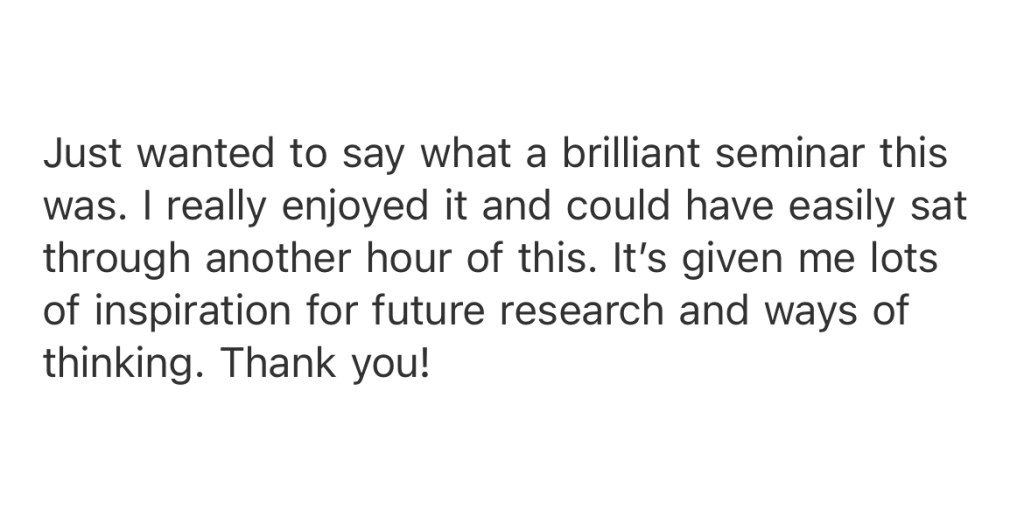
I put my headphones on and listen to Classic FM, which is a good distraction. Eventually, I arrive at my station, get in my car and five minutes later I am home. Today has been saturating, stimulating and affirmative. I receive an email on the way back which has some very positive feedback from someone who joined. It shows that the ACT project is powerful and important. What an opportunity.
The dogs are overwhelmed and so excited to see me. Where on earth have you been? We have missed you. Welcome home. We are starving. Food now, please. I let them out and Wilby races in accelerated zoomies around my garden, at lightning speed.
It’s too fast, it’s too late. Let’s go to bed, I say to the dogs. We go upstairs. I sleep for 2 ½ hours and wake up. It is still the same day. And the next day starts again. Many things to do today! How exciting. Or is it still yesterday? Bit confusing. Time is out of joint.
But yesterday (or today) is marvellous. Long may it continue.
 A Creative Transformation